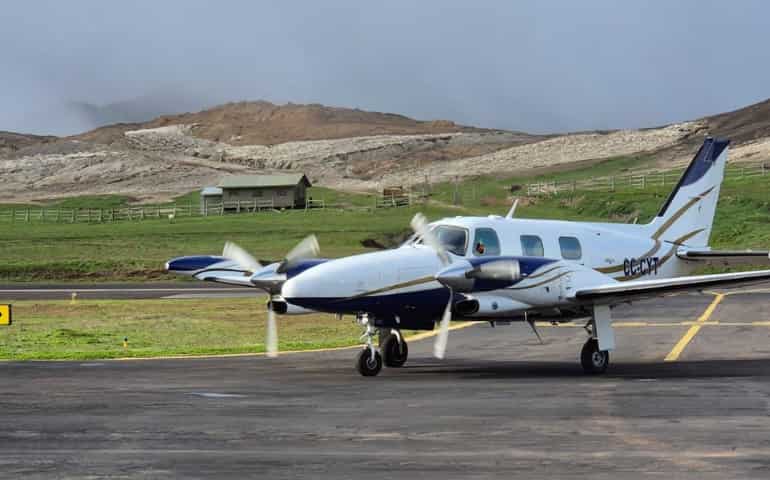
Chile is one of the most geographically demanding countries in the world for transport planning. Its territory stretches across deserts, mountains, fjords, islands, and long coastal distances, making aviation far more than a luxury in many regions. In remote parts of the country, aircraft often function as essential infrastructure, connecting communities that would otherwise face long, uncertain, or highly limited access by land or sea. Few places illustrate this reality more clearly than Robinson Crusoe Island in the Juan Fernández Archipelago, where air service plays a central role in linking a distant Pacific community with mainland Chile.
When people talk about “Transportes Aéreos Isla Robinson Crusoe,” they are generally referring to the niche aviation services that make travel to the island possible. These services are represented most visibly by operators such as Aerolíneas ATA and Aerocardal, which maintain connections between Santiago and the archipelago through small-aircraft operations tailored to a highly unusual route. Their role is bigger than simply selling tickets. They help sustain access to a national park, a UNESCO Biosphere Reserve, a local community, and a zone of scientific and environmental significance.
Why aviation matters in remote Chile
Mainland Chile has a strong road network in many populated areas, but that model breaks down when communities are separated by open ocean. The Juan Fernández Archipelago lies far off the coast, and official and travel-industry sources describe reaching it by air from Santiago as a journey of roughly 1 hour 50 minutes to 3 hours depending on the operator and trip format. By sea, the trip can take 48 to 72 hours or more depending on conditions, which immediately shows why aviation matters so much for time-sensitive travel.
This dynamic is common in remote Chile. Aviation compresses distance, supports access to places where regular mass transport is not viable, and allows small communities to remain connected to the political and economic center of the country. In that sense, the Robinson Crusoe route is not an isolated curiosity. It is part of a broader Chilean pattern in which air transport fills gaps created by geography.
The importance of such services also extends beyond tourism. Aerolíneas ATA describes itself as a company specializing since 1988 in passenger transport and critical transport services, including air ambulance, cargo, surveillance, patrol, and maintenance-related aviation activity. That profile reflects the multifunctional nature of remote aviation in Chile: operators often do much more than carry tourists.
Robinson Crusoe as a case study
Robinson Crusoe Island is a particularly useful case because it combines remoteness, environmental sensitivity, small population scale, and strong symbolic value. Aerolíneas ATA presents the island as one of Chile’s most remote and historic destinations, reachable from Santiago in about 1 hour and 50 minutes. Aerocardal similarly frames flights to Juan Fernández as access to a “natural haven steeped in history,” while emphasizing that the archipelago is a national treasure and a delicate ecosystem.
This combination makes aviation especially consequential. Without regular air links, access to the island would rely much more heavily on slower maritime services, which are useful but cannot fully replace the flexibility of aircraft for urgent, professional, and short-stay travel. In practice, island connectivity depends on having aviation operators able to work within short-runway, low-volume, and weather-sensitive conditions.
That is where the role of Transportes Aéreos tied to Robinson Crusoe becomes clear. These operators are not trying to turn the route into a mass-market corridor. Instead, they sustain a specialized link in which safety, schedule coordination, aircraft suitability, and local knowledge matter more than scale.
The operators behind the route
Two names stand out most clearly in public information about flights to Robinson Crusoe Island: Aerolíneas ATA and Aerocardal. ATA’s profile shows a company with a broad service portfolio across executive, critical, cargo, and remote-destination aviation, and it explicitly includes Robinson Crusoe among its destination offerings. That matters because it suggests the island route sits within a broader operational culture built around flexibility and complex mission types rather than only standard tourism transport.
Aerocardal, meanwhile, says it publishes regular annual schedules for Juan Fernández and offers both scheduled and charter flights to the archipelago. It also highlights the use of the Let L-410NG aircraft on the route, describing it as particularly suited to the island’s runway conditions and geography. That aircraft fit is a major part of the story in remote aviation. When operating into constrained environments, the right aircraft can determine whether a route is feasible, safe, and economically sustainable.
Together, these operators illustrate how aviation in remote Chile often depends on medium-size specialized companies rather than giant network airlines. Their value lies in adaptability, route expertise, and the ability to serve places where conventional commercial models do not always fit.
More than tourism
A common mistake is to think of Robinson Crusoe flights purely as adventure travel. Tourism is important, but the route also supports residents, work teams, researchers, and mission-driven travel. Aerocardal explicitly says its Juan Fernández services are designed for explorers, scientists, business travelers, tourists, and work teams, underscoring the mixed-use nature of the connection.
This is a defining feature of remote aviation. In large urban markets, airlines often segment travelers neatly into leisure or business categories. On routes like Robinson Crusoe, those categories overlap. The same aircraft network may be moving a tourist one week, technical personnel the next, and a group with environmental or operational purposes after that.
That flexibility is especially important in island settings. A remote archipelago does not just need visitor access. It needs a living connection to the mainland, and air transport helps preserve that link even when volumes are low. In that respect, the role of these operators is infrastructural as much as commercial.
Aircraft, runway, and operational logic
One of the clearest technical dimensions of this story is aircraft suitability. Aerocardal states that it operates the Let L-410NG on the Juan Fernández route and presents the aircraft as well adapted to the island’s unique runway conditions and terrain. Public social media material associated with the route also highlights STOL, or short takeoff and landing, capability as a valuable trait for operating at Robinson Crusoe.
This matters because remote aviation is not simply about flying farther. It is about matching aircraft performance to real-world infrastructure constraints. In mainland hub-to-hub operations, airlines can standardize around large airports and predictable systems. In island operations, runway length, wind, weather, transfer logistics, and turnaround practicality all become much more significant.
Robinson Crusoe therefore serves as a good example of how remote aviation in Chile is shaped by environment. The route is viable because operators tailor equipment and service design to the location, not because the location conforms to the assumptions of mainstream commercial aviation.
Connectivity and national cohesion
Aviation to Robinson Crusoe Island also has a political and social meaning. Aerocardal says it takes pride in supporting the connectivity of the archipelago and its residents, helping maintain a vital link between this distant territory and mainland Chile. That statement reflects a larger truth: remote air routes help reinforce national cohesion by making peripheral communities more reachable.
Chile’s geography can easily fragment transport systems. Islands and distant coastal areas are especially vulnerable to that fragmentation, which is why a functioning air link has significance beyond passenger numbers. It supports mobility, service access, and a sense that remote territories remain integrated into the life of the country.
This is especially relevant in a place like Juan Fernández, which is globally known for nature and history but still home to a real resident community. Aviation helps ensure that such places are not treated only as scenic outposts for outsiders, but as inhabited parts of Chile with practical connectivity needs.
Challenges of operating the route
Operating in remote Chile is never simple. Weather, low traffic density, infrastructure constraints, and high unit costs all make routes like Robinson Crusoe demanding. Even when operators publish schedules, flexibility remains part of the operating reality because island environments are inherently less predictable than major city pairs.
This challenge helps explain why such routes are usually served by specialized operators rather than large network airlines. The business case depends not on huge passenger volumes, but on reliability within a niche market and a service model adapted to irregular conditions. It also explains why passengers often experience a more hands-on booking process and why these flights are often framed as an adventure even before departure.
In practical terms, Transportes Aéreos serving Robinson Crusoe occupy an unusual middle ground. They are commercial providers, but they operate in ways that resemble utility services for remote geography. That dual role is one of the most interesting features of aviation in Chile.
What this says about Chilean aviation
The Robinson Crusoe route reveals a broader truth about Chilean aviation: the country’s air system is not only about high-volume trunk routes between big cities. It also includes a quieter but extremely important layer of specialized connectivity linking the mainland with difficult-to-reach territories. In those spaces, operators like Aerolíneas ATA and Aerocardal perform a role that is strategic, social, and logistical all at once.
They connect a remote island to the capital, support tourism without depending solely on tourism, and demonstrate how aviation can act as territorial glue in one of the world’s most geographically challenging countries. That is why the role of Transportes Aéreos Isla Robinson Crusoe is so significant. It is not simply about getting passengers to a beautiful island. It is about how aviation makes remote Chile function.